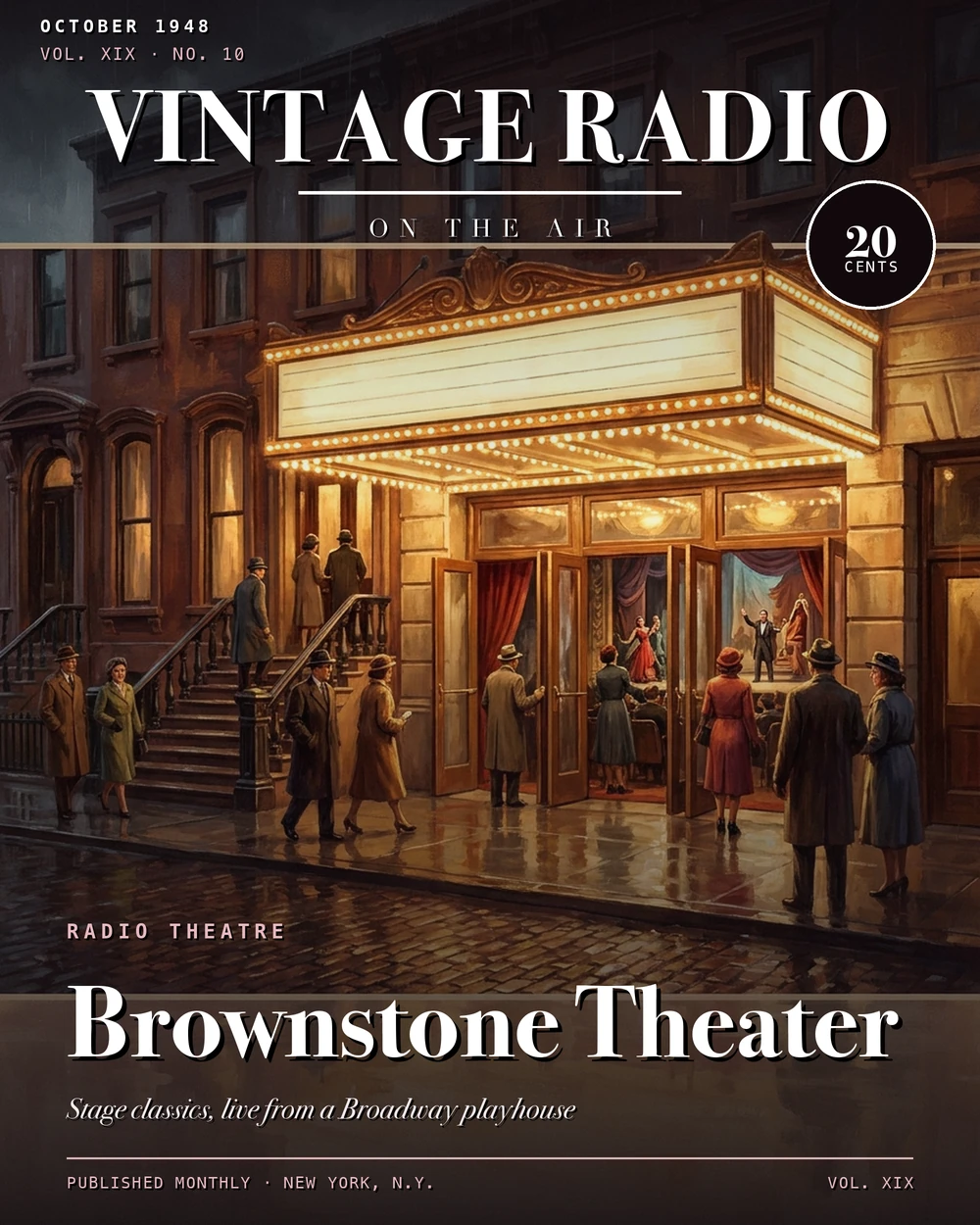
Brownstone Theater
The Conceit Behind the Curtain
What set Brownstone Theater apart from the average dramatic anthology wasn't the material — it was the frame around it. The show billed itself as "a theater of memories, your own memories, perhaps," and it meant that literally. Each episode pulled the listener through a theatrical experience complete with curtains, greasepaint, and the ambient suggestion of an audience settling into their seats. A narrator led you to your place in the Brownstone Theater, and then the play began. The format had a faint kinship with the long-running First Nighter Program — another show built around the ritual of arriving at a fictional theater — but Brownstone Theater had something First Nighter didn't: it was actually produced inside a real Broadway house.
The show originated at WOR in New York, but its production home was the Longacre Theatre at 220 West 48th Street in Midtown Manhattan, which WOR had leased from the Shubert Organization beginning around 1943 or 1944. Broadcasting from an actual theater gave the atmospheric trappings something to anchor themselves to. Sylvan Levin provided the music, Jock MacGregor directed, and the whole operation ran as a 30-minute drama on Wednesday evenings at 9:30 on the Mutual network, from February 21, 1945 through September 23, 1945.
The Stories It Told
The promotional copy was refreshingly honest about what audiences were getting: "plays that have entertained and thrilled many an audience in many a theater, plays you will still enjoy." A contemporary radio listing put it even more plainly, describing the material as "Revivals of some of the plays that thrilled Grandpa and Grandma." The show adapted well-known classics — chestnuts, in the affectionate sense of the word. The roster included The Man Without a Country, The Prisoner of Zenda, and Cyrano de Bergerac. The very first episode, broadcast on February 21, 1945, was an adaptation of The Lion and the Mouse.
The writing staff was a working collective rather than a single voice. Adaptations came from Peggy L. Mayer, Anzie Strickland, Florence North, Gladys Milliner, Eleanor Abbey, Keith Thompson, and MacGregor himself. The supporting cast was equally broad, with performers including Inge Adams, Jan Miner, Elissa Landi, Jane Cowl, Edward Rose, Neil Hamilton, Walter Hampden, Michael Fitzmaurice, and Shep Menken cycling through the studio across the seven-month run.
The overall effect was a pleasant, fluffy half-hour — not trying to be more than it was, not pretending the material was fresh when its appeal was precisely the familiarity of it.
The Narrator Who Had Been There
Clayton Hamilton was the show's narrator, and the choice was more than decorative. Hamilton — full name Clayton Meeker Hamilton, born November 14, 1881 — had been a working drama critic during the original Broadway runs of many of the plays Brownstone Theater was now adapting for radio. He wasn't trading on nostalgia secondhand. He had actually been in the theaters.
Hamilton's credentials were formidable. He served as dramatic critic and associate editor of The Forum from 1907 to 1909, dramatic editor of The Bookman after 1910, Everybody's Magazine after 1911, and Vogue after 1912. He lectured on drama at Columbia University, sat on the Pulitzer Prize Committee for Drama for sixteen seasons between 1912 and 1934, and wrote influential books including The Theory of the Theatre (1910), Studies in Stagecraft (1914), and Problems of the Playwright (1917). As a guide leading listeners through a theater of old plays, nobody was better qualified.
Hamilton died of a coronary thrombosis at his home in New York City on September 17, 1946, less than a year after Brownstone Theater ended its run. His papers — correspondence, diaries, lectures, plays, and contracts spanning 1899 to 1946 — are held by the New York Public Library's Manuscripts and Archives Division.
The Two Leading Men
Jackson Beck played the male lead when the show launched in February 1945. Beck was New York radio through and through — born in the city on July 23, 1912, son of a stage and silent-film actor, he began his radio career in 1931 at WINS and WHN and was a founding member of the American Federation of Radio Artists in 1937. During his time on Brownstone Theater, he was simultaneously serving as announcer-narrator for The Adventures of Superman on Mutual and ABC, and starring as The Cisco Kid on Mutual from 1942 through 1945. Beck carried a heavy schedule in those years, and his departure from the show in July 1945 — roughly four months before the series ended — may simply reflect the demands on his time. He went on to a long career and died on July 28, 2004, five days after his 92nd birthday, of complications from strokes.
His replacement was Les Tremayne, and the casting made obvious sense to anyone who knew their radio. Tremayne — born Lester Tremayne in Balham, London, on April 16, 1913, and raised in Chicago from age four — had previously starred as the leading man on The First Nighter Program from 1936 to 1942, replacing Don Ameche in that role. The First Nighter Program was the closest thing radio had to a template for what Brownstone Theater was doing, which made Tremayne something like a specialist in the format. A survey conducted during his peak years identified him as having one of the three most distinctive voices on American radio, ranking alongside Bing Crosby and President Franklin D. Roosevelt. Tremayne was elected to the National Radio Hall of Fame in 1995, and died of heart failure in Santa Monica on December 19, 2003, at age 90.
Gertrude Warner played opposite both leading men, holding the female lead across the run.
A Radio Show That Became Television, Too
Producer Bob Emery found a way to stretch Brownstone Theater beyond its Wednesday-night radio broadcast. Some episodes were simultaneously filmed via kinescope as they aired live, then broadcast two or three weeks later on WABD, the DuMont Television Network's New York City station. At least four episodes also reached WRGB, the General Electric television station in Schenectady, New York.
The modifications required to make a radio drama work on television were minimal. Producers added, as Emery described it, "a miniature stage and curtains through which to introduce and close each television presentation." The show's existing theatrical framing — the curtains and atmosphere already built into the radio format — translated almost directly to the screen. Emery later cited Brownstone Theater as one of the shows he considered a reasonable example of small-budget dramatic television production in the mid-1940s, a period when such things were still being figured out as they went. The Longacre Theatre, which had enabled that production environment, returned to legitimate theatrical use in 1953 after nearly a decade as a Shubert-leased broadcast facility.
What Survives
Brownstone Theater ran for sixteen episodes in its first cycle, according to available catalogs. Of those, only four recordings are known to survive, with a combined running time of just under two hours. That's a thin remnant of a seven-month run — not unusual for a 1945 Mutual drama that wasn't a flagship property, but a reminder of how much of that era simply didn't make it through.
What those four episodes represent is a specific moment in radio production: a show that leaned into the past deliberately, adapted classic stage material for an audience that found comfort in familiarity, and managed to briefly bridge radio and the earliest days of television in the same production. The Brownstone Theater itself never existed, but for a few months in 1945, the fiction of walking into it was produced inside a real theater on West 48th Street by people who knew their way around the material they were reviving.